

MLeads.ai · Smarter Lead Management
Capture, track & convert every lead from one platform.
2026 Playbook
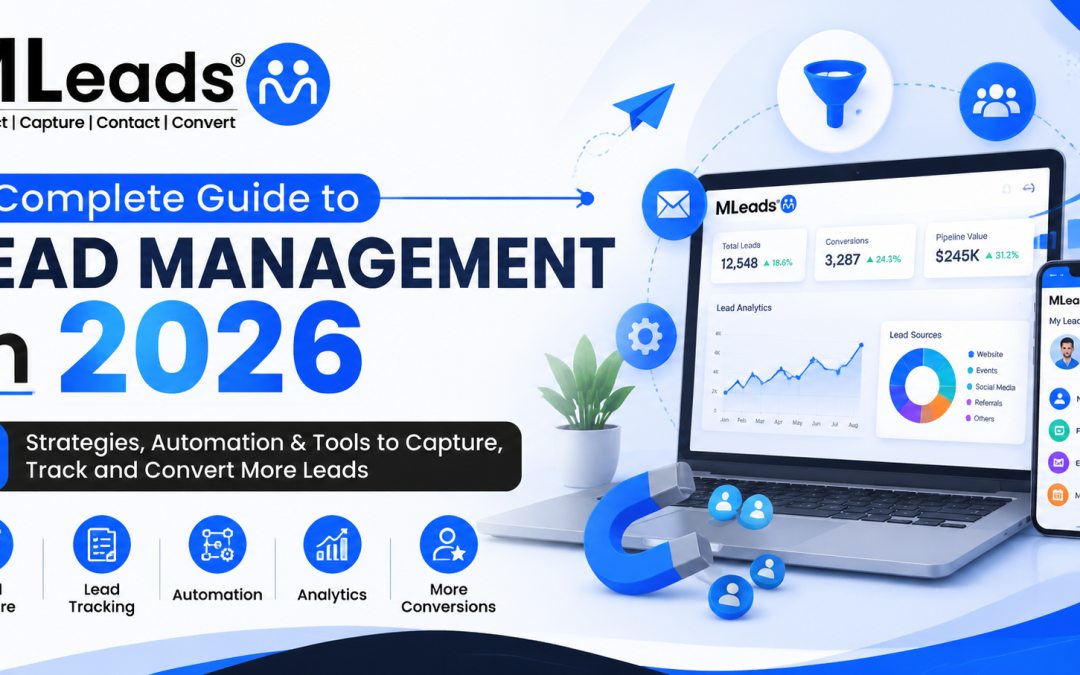
A Complete Guide to Lead Management in 2026
Introduction
In 2026, businesses are generating more leads than ever before—yet many still struggle to convert those leads into paying customers. The challenge is no longer finding prospects; it is effectively capturing, tracking, nurturing, and converting them.
AI and automation have reshaped lead management. Teams have adopted mobile-first CRM solutions and omnichannel communication. If you’re still working from spreadsheets and chasing leads by hand, you’re almost certainly leaving money on the table. The right lead generation automation tools speed up outreach to prospects and boost conversion rates.
Systematic lead management helps organisations connect better with clients, prioritise prospects, automate repetitive duties, and nurture richer relationships across the entire sales cycle.
What Is Lead Management?
Lead management is the process of capturing, tracking, organising, nurturing, qualifying, and converting prospects into paying clients.
Leads can come from many places:
- Website forms
- Social media advertising
- Business card images
- Events and exhibitions
- Referral programmes
- Email marketing
- Paid advertising
- QR code scans
- NFC business cards
The truth is, lead management is fairly straightforward in principle: send the right message to the right lead at the right time, until they become a customer.
The problem is execution. Most teams are inundated with emails, spreadsheets, notes, and a dozen disconnected platforms with no clear plan for their leads—which means inadequate follow-up and lost sales.
Why Lead Management Matters in 2026
Client expectations are changing. Today’s prospects expect:
Easy communication
Scheduled follow-ups
Multi-channel engagement
Relevant content
Studies consistently show that companies which reply quickly to an initial inquiry win more business than those that delay follow-up.
A modern lead-tracking system helps businesses:
- Reduce response times
- Improve lead visibility
- Increase team productivity
- Generate higher conversion rates
- Improve ROI measurement
Companies that implement effective lead management strategies often see stronger pipeline growth and more predictable revenue.
Understanding the Lead Management Lifecycle
Generate Leads
The first step is collecting prospect data. Modern organisations generate leads through landing pages, web forms, AI chatbots, event registration, business card scanners, QR codes, NFC technology, and social media campaigns.
Use mobile apps and scanning technology to capture leads fast. MLeads.ai offers many capture methods—business card scanning, QR codes, audio, badges, manual entry, and proximity sharing.
Track Leads
Once captured, leads need to be nurtured through the sales cycle. Effective tracking covers contact information, source attribution, communication history, website activity, email engagement, meeting schedules, and sales opportunities.
Tracking ensures sales professionals always know where a lead sits in their buying journey. Without it, a company loses visibility into its client interactions and cannot reliably rate prospects.
Qualify Leads
Not every lead is ready to buy. Qualification helps you understand four things: Budget, Authority, Need, and Timing (BANT).
Strong prospects move faster through the funnel. Today’s enterprises use AI-powered lead scoring to automatically pinpoint high-value prospects based on behavioural and engagement signals.
Nurture Leads
Most leads aren’t ready to buy immediately, so nurturing builds the trust that closes deals. Lean on email marketing, educational content, product demos, case studies, workshops, and personalised communication—keeping the prospect warm until they’re ready to buy.
Convert Leads
Conversion turns a lead into a customer. This stage typically includes product demos, proposal submission, pricing guidance, negotiation, and signing the contract. Strong sales technique closes far more of these.
What Is Lead Generation Automation?
Lead generation automation uses software and AI to automate acquiring, collecting, qualifying, nurturing, and converting leads. Instead of reacting to every event as it happens, your team runs on automated, repeatable processes.
Common examples include:
- Automated email campaigns
- Lead assignment workflows
- AI-driven lead scoring
- Follow-up reminders
- Event lead capture
- CRM integrations
- Meeting scheduling
Automation generates leads for you and frees sales specialists from administrative drudgery so they can focus on closing business.
Key Components of a Modern Lead Tracking System
Lead Database
Every candidate in one place. Benefits include greater visibility, faster access, improved teamwork, and less redundancy.
Activity Monitor
Every interaction recorded automatically—calls, emails, meetings, tasks, notes, and status changes—for full visibility into engagement history and sales progress.
Communication Management
Email marketing, SMS, call history, and automated follow-ups in one hub—a better customer experience and more efficient staff.
Reporting & Analytics
Track lead volume, conversion rate, pipeline value, email engagement, team performance, and source effectiveness to surface bottlenecks.
Lead Management Tips for 2026
Respond Quickly
Time is money, and competitors are circling. The first company to respond usually wins. Automate alerts and workflows so responses go out faster.
Use AI for Prioritisation
AI helps identify high-intent prospects, buying signals, engagement patterns, and conversion probability—so your team focuses on the leads most likely to close.
Follow Up Automatically
Follow-up is one of the highest-leverage things you can do. Workflow automation ensures no lead is forgotten, messages arrive on time, and communication stays consistent. Automated teams are simply more persistent than non-automated ones.
Segment Leads Properly
Common segments include industry, location, company size, product interest, event source, and buying stage. Well-segmented outreach typically drives better engagement and conversion.
Align Marketing & Sales
Lead management works best when sales and marketing share goals. Alignment improves lead quality, communication consistency, conversion efficiency, and customer experience—everyone working from one version of the truth.
AI and Sales Lead Management Software
AI is transforming how sales teams work—across four areas in particular.
Lead quality measurement. AI reviews engagement behaviour, website interactions, email responses, and historical patterns to automatically prioritise the best opportunities.
Likelihood of conversion. Predictive models estimate purchase intent, transaction value, and closing timeline, so sales staff focus where it counts.
Automated data capture. AI-powered business card and badge scanners capture contact information accurately—eliminating manual data entry and reducing errors.
Actionable insights. AI surfaces pipeline bottlenecks, follow-up opportunities, customer sentiment, and sales trends to support better decisions.
Lead Management at Events in 2026
Events remain one of the best places to gather high-quality leads—the question is how to do it efficiently. Modern event lead management combines:
- Business card scanning
- Badge scanning
- QR code scanning
- Real-time lead distribution
- Automated follow-up
- Event-specific reporting
Common Lead Management Challenges
Missed opportunities. Manual methods can’t catch every signal. Automation means every lead receives attention.
Poor data quality. Incomplete data hurts sales. Validation and enrichment tools keep records accurate.
Lack of visibility. Many teams can’t see lead status, team performance, or pipeline health. Reporting dashboards solve this.
Inconsistent follow-ups. Keeping up manually is hit-or-miss. Automated workflows make communication consistent.
How to Choose a Sales Lead Management System
When evaluating platforms, confirm they include:
- Lead generation automation
- Responsive, mobile-friendly design
- AI-powered lead scoring
- Business card & QR code scanning
- Automated email marketing
- Team collaboration
- Pipeline management
- Analytics & reporting
- CRM integration
- Event management
- Workflow automation
The best solutions unify lead acquisition, nurturing, communication, and reporting into a single platform.
Lead Management Metrics to Track
Number of Leads
How many leads each source produces—so you know where to invest your time.
Conversion Rate
The share of leads that become customers—a direct read on your follow-up process.
Response Time
How quickly you reach a new lead. Faster replies build trust and lose fewer leads.
Cost Per Lead (CPL)
What you spend to generate each prospect—focus budget on low-cost, high-quality sources.
Pipeline Value
The sum of all potential revenue in your pipeline—helps forecast and target high-value deals.
Customer Acquisition Cost
Total sales & marketing spend to win one customer. Lower it without losing quality.
Sales Cycle Length
How long it takes to convert a lead. A shorter cycle means leads move faster through the funnel.
The Future of Lead Generation Automation
Lead generation automation will only accelerate. Key trends to watch:
- AI and deeper personalisation
- Predictive lead scoring
- Voice-enabled CRM engagement
- Advanced sentiment analysis
- Automated customer roadmaps
- Live, real-time interaction
- Intelligent workflow optimisation
Together, these bring major gains in efficiency, responsiveness, and customer experience.
Conclusion
Lead management in 2026 is about far more than storing contacts. Intelligent automation and data-driven decisions make it simple to acquire, track, nurture, and convert prospects.
With today’s advanced lead tracking systems and AI-powered sales software, firms can reply faster, tailor conversations, lift conversion rates, and capture more revenue. AI is reshaping sales operations at a breakneck pace—and the companies that start automating now will be best positioned to compete, scale, and succeed.
Whether you’re a small business, a sales team, an event organiser, or a large enterprise, a rock-solid lead management system is one of the best long-term investments you can make.
MLeads.ai — The Smarter Way to Manage Leads
Capture, track, nurture & convert — all in one platform.
AI-powered lead analysis, business card scanning, event capture, automated follow-ups, reporting, and team collaboration—built to grow your pipeline.