

AI-Powered CRM
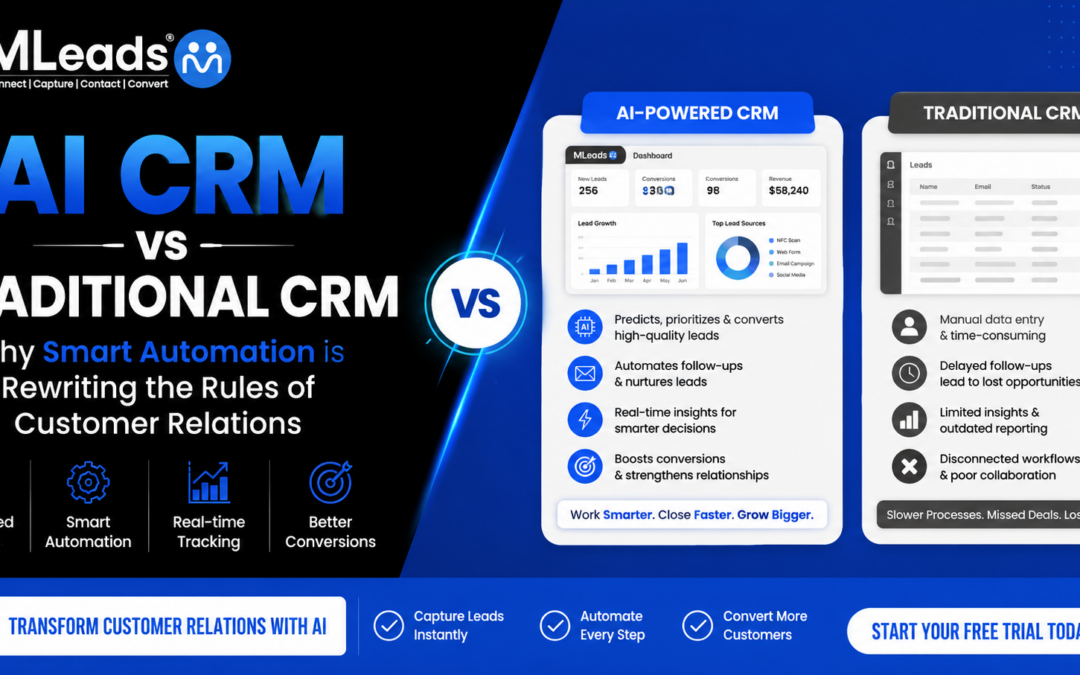
AI CRM vs Traditional CRM: Why Smart Automation is Rewriting the Rules of Customer Relations
Move from a passive digital filing cabinet to an intelligent co-pilot that predicts, automates, and personalizes at scale.
Managing customer relationships has always been the cornerstone of business growth, but the tools we use to do it are undergoing a massive shift. For decades, traditional Customer Relationship Management systems served as the digital filing cabinets of the corporate world. They were reliable, structured, and entirely dependent on human input. Today, the rise of the AI CRM is fundamentally changing that dynamic, transforming software from a passive storage system into an active, intelligent co-pilot.
For businesses striving to stay competitive, understanding the divide between a traditional setup and an AI CRM is no longer just an academic exercise. It is a critical operational decision. The modern marketplace moves at a speed that manual data entry simply cannot sustain. By examining how artificial intelligence redefines interaction tracking, data analysis, and workflow execution, we can see exactly why modern enterprises are leaving legacy frameworks behind in favor of smarter, more adaptive ecosystems.
Understanding the Foundations: What is a Traditional CRM?
To appreciate the impact of artificial intelligence, it is essential to first understand the baseline. A traditional CRM is a centralized database where businesses store customer information, interaction histories, sales pipelines, and support tickets. It functions primarily as a system of record. When a sales representative makes a call, sends an email, or closes a deal, they must manually log those details into the system to keep the records accurate.
While traditional platforms revolutionized business by breaking down data silos across departments, they possess inherent limitations. They are backwards-looking, meaning they only show you data that has already been collected and logged. They rely heavily on human discipline; if a representative forgets to update an account record, the integrity of the entire system suffers. Essentially, traditional software acts as a digital ledger that requires constant manual maintenance to remain useful.
The Evolution: Enter the AI CRM
An AI CRM represents a paradigm shift from a system of record to a system of intelligence. Instead of merely housing data, it actively analyzes information, uncovers hidden patterns, predicts future outcomes, and automates complex tasks. This evolution is driven by machine learning, natural language processing, and advanced data analytics working quietly beneath the user interface.
With a crm with ai features, the software actively assists the user. It can read an incoming email, understand the customer’s sentiment, suggest the best response, and automatically update the sales pipeline stage without human intervention. It removes the burden of administrative upkeep, allowing teams to focus on strategy and relationship-building rather than data entry.
Data Entry & Management: Manual Upkeep vs. Autonomous Accuracy
The day-to-day experience of using a traditional platform is often defined by administrative friction. Sales professionals frequently complain about the sheer volume of hours spent typing notes, updating contact fields, and moving deals from one stage to another. This manual process is not only time-consuming but also highly prone to human error, resulting in fragmented or outdated customer profiles.
In stark contrast, an AI CRM treats data management as an autonomous background process. By utilizing continuous crm automation, the system automatically captures data from various touchpoints like emails, calendar invites, phone logs, and social media interactions. It parses this unstructured data, extracts relevant details, and populates the correct fields automatically. This ensures that customer profiles remain accurate, comprehensive, and up-to-date in real time, giving teams a clean foundation of data they can actually trust.
Lead Management & Scoring: Guesswork vs. Predictive Precision
In a conventional setup, managing leads often relies on rigid, rule-based scoring models designed by sales managers. Points are awarded based on basic criteria, such as a lead downloading a whitepaper or visiting a specific web page. While helpful, these static models fail to capture the nuanced behaviors that truly indicate an intent to purchase, often leading teams to chase cold prospects while warm opportunities cool down.
Modern systems approach this challenge through an advanced lead management crm framework powered by predictive algorithms. Instead of relying on static rules, the intelligence analyzes historical conversion data to identify the exact characteristics of your ideal customer. It evaluates hundreds of variables simultaneously, adjusting lead scores dynamically based on real-time behavior. This level of predictive precision ensures that your sales team always focuses their energy on the accounts most likely to convert.
Lead Management Evolution
Traditional CRM
Static, rule-based scoring → Manual sorting → Delayed follow-up
AI CRM
Predictive algorithms → Autonomous prioritization → Real-time engagement optimization
Sales Forecasting: Historical Averages vs. Machine Learning Foresight
Accurate sales forecasting is critical for resource allocation, inventory management, and strategic planning. Traditional platforms generate forecasts by looking backward. They take historical sales numbers, apply a standard win-rate percentage to the current pipeline, and project an expected outcome. This method assumes that the future will mirror the past exactly, completely ignoring shifting market dynamics or individual deal anomalies.
Transitioning to an AI CRM replaces these basic historical calculations with sophisticated machine learning foresight. The software looks beyond simple pipeline stages to analyze deep contextual factors, such as the sentiment of recent emails, the time elapsed since the last interaction, and broader economic indicators. By weighing these complex variables, it delivers highly accurate forecasts that flag potential shortfalls early enough for management to intervene.
Customer Support: Reactive Resolution vs. Proactive Engagement
The customer support experience in a traditional setup is almost entirely reactive. A customer encounters an issue, opens a support ticket, and waits for an agent to review the case, diagnose the problem, and respond. While workflows can route tickets to the right department, the speed of resolution is ultimately bottlenecked by human bandwidth and the clarity of the initial ticket details.
Integrating a crm with ai features transforms this workflow into a proactive customer care engine. Intelligent conversational bots can instantly handle routine inquiries, resolving common issues without ever involving a human agent. For complex problems, the system summarizes long ticket histories, detects customer frustration through sentiment analysis, and routes the case to the best-suited specialist along with suggested solutions, drastically reducing resolution times.
Workflow Automation: Linear Rules vs. Dynamic Orchestration
Traditional software uses basic conditional logic – often referred to as “if-this-then-that” rules – to automate basic tasks. For example, if a lead form is submitted, the system can automatically send a standard follow-up email. While this basic automation saves time, it is highly rigid and struggles to handle complex, non-linear customer journeys that diverge from the pre-written script.
True crm automation driven by artificial intelligence functions like a dynamic orchestrator. It observes user behavior and customer responses to optimize workflows on the fly. If a prospect skips a step in the expected journey, the system recognizes the context and alters the outreach strategy. It can recommend the optimal time to send an email, suggest the most effective communication channel, and personalize content dynamically for each recipient, creating a highly customized experience at scale.
“When software feels like a helpful assistant instead of an administrative chore, adoption rises, data gets richer, and ROI follows.”
User Adoption & Software ROI: The Administrative Burden Shift
One of the most significant hidden costs of traditional systems is low user adoption. When software feels more like an administrative chore than a helpful asset, sales reps naturally resist using it. They maintain their own private spreadsheets, causing valuable data to live outside the corporate ecosystem, which ultimately erases the return on investment for the software.
An AI CRM solves this adoption problem by shifting the administrative burden away from the employee. Because the system handles data entry, schedules follow-ups, and logs interactions autonomously, team members view the software as a helpful assistant rather than a supervisor. Lowering this operational friction leads to higher adoption rates, richer data collection, and a much stronger return on the company’s technology investment.
Scalability & Personalization: The Modern Business Dilemma
As a business grows, maintaining a personalized touch with thousands of customers becomes incredibly difficult. In a traditional setup, scaling up usually requires hiring more account managers to maintain that personal connection. Without expanding headcount, communication naturally becomes generic, mass-blast marketing that alienates modern buyers who expect tailored experiences.
Deploying a smart lead management crm allows organizations to scale their operations without losing their personal touch. The system processes massive volumes of customer data simultaneously, uncovering unique preferences and behaviors for every single contact. This allows marketing and sales teams to deliver deeply personalized content, product recommendations, and timely follow-ups to thousands of prospects at once, successfully blending enterprise-scale efficiency with boutique-level personalization.
Making the Switch: Key Considerations for Business Leaders
Transitioning from a legacy platform to an advanced system requires careful planning and a clear understanding of your organization’s specific needs. It is not just about choosing a platform with the most features; it is about finding a solution that integrates smoothly with your current technology stack and aligns with your long-term business strategy.
Assessing Data Maturity & Readiness
Before deploying advanced software, evaluate the quality of your current database. Intelligent algorithms rely entirely on clean data to generate accurate insights and predictions. Spending time cleaning up duplicate accounts, fixing broken formatting, and organizing old records ensures that your new system has a solid foundation to learn from right from the start.
Prioritizing User Training & Change Management
Introducing artificial intelligence can sometimes cause anxiety among team members who worry about technology replacing their roles. Address this early by emphasizing how the software eliminates repetitive administrative work, freeing them up to focus on closing deals and building relationships. Structured training ensures that everyone understands how to leverage these new tools effectively.
Evaluating Integration & Infrastructure Compatibility
A smart system should not operate in a vacuum. It needs to connect seamlessly with your existing email networks, marketing platforms, and internal databases. When choosing a solution, prioritize platforms that offer robust application programming interfaces and pre-built connectors, ensuring a smooth, uninterrupted flow of information across your entire business infrastructure.
Choosing the Right Path for Long-Term Growth
The choice between a legacy system and a modern alternative is not merely a matter of updating software. It represents a fundamental decision on how your company values its time, its data, and its customer relationships. While traditional systems served their purpose in an earlier digital era, they are increasingly becoming liabilities in a fast-moving, data-driven marketplace.
Investing in an AI CRM gives businesses the tools to anticipate customer needs, automate complex operational workflows, and make strategic decisions based on accurate, predictive data. As artificial intelligence continues to advance, the gap between traditional manual tools and intelligent platforms will only widen. Embracing a crm with ai features today ensures your business stays agile, efficient, and ready to meet the evolving expectations of the modern customer.
Ready to Trade Manual Upkeep for Intelligent Automation?
See how an AI-powered CRM captures data automatically, scores leads predictively, and personalizes outreach at scale — without adding headcount.