

Types of Customer Relationship Management (CRM): A Comprehensive Guide
A growing business rarely loses customers because its team doesn't care. It loses them when information is scattered across inboxes, spreadsheets, phones, and individual memories — this guide breaks down every type of CRM and how to choose the right one.
This is the problem customer relationship management is designed to solve. It creates a structured way to collect customer information, coordinate communication, track opportunities, and learn from every interaction. Yet choosing a platform can be confusing because products are described with terms such as operational, analytical, collaborative, strategic, mobile, social, and industry-specific.
The easiest way to understand these labels is to focus on the job each type performs. Some tools support daily sales and service work, others interpret data, connect departments, or guide long-term strategy. This guide explains the major types, how they work together, and how to choose without buying unnecessary complexity.
What Is Customer Relationship Management?
Customer relationship management is both a business strategy and a technology-supported process. It helps an organization understand who its customers are, what they need, how they interact with the business, and what should happen next.
The technology usually stores contact details, communication history, lead sources, tasks, opportunities, service issues, preferences, and performance data. The strategy defines how the business will use that information to attract suitable prospects, respond consistently, retain customers, and improve each relationship.
A CRM system is more than a digital address book. It can show where a contact came from, who owns the relationship, what has happened, what the prospect needs, and whether a follow-up is overdue.
That connected process is the practical value of CRM software: it turns isolated interactions into an organized relationship history.
Why Different Types of CRM Exist
Organizations manage customers differently. A field sales team needs mobile lead capture and reminders. A subscription company may prioritize retention and churn risk. A larger organization may need sales, marketing, and support to share one record, while executives may want profitability and segmentation insights.
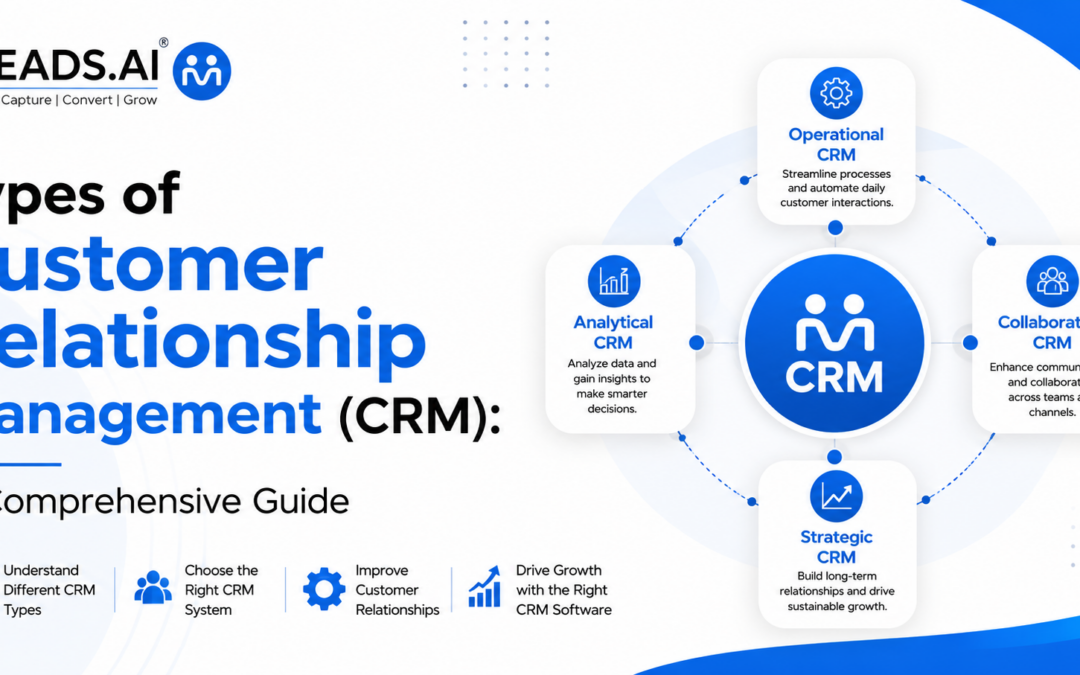
The three most widely recognized types of customer relationship management are operational, analytical, and collaborative CRM. Strategic CRM is also commonly treated as a fourth type because it focuses on long-term customer value.
Other labels, including campaign, contact management, social, mobile, and industry-specific CRM, usually describe a specialized use case rather than a separate foundation. That distinction prevents buyers from comparing labels instead of examining the process that needs improvement.
The Four Core Types of CRM
Each type answers a different question about the customer relationship.
Supports the routine work of attracting prospects, moving opportunities forward, and serving customers — through sales automation, marketing automation, and service automation.
Turns customer data into insight — segmentation, forecasting, campaign measurement, and AI-assisted lead scoring and pattern detection.
Connects the people and channels involved in a relationship — shared interaction history, channel coordination, and clean team handoffs.
Places long-term customer value at the center of business decisions — customer selection, retention models, and company-wide decisions shaped by customer evidence.
1. Operational CRM
Operational CRM supports the routine work involved in attracting prospects, moving opportunities forward, and serving customers. It is the most visible form of customer relationship management because employees use it throughout the day to record activities and complete actions.
Its purpose is simple: reduce manual effort, create repeatable workflows, and make the next step clear.
Sales Automation
Sales automation organizes activities from initial contact through conversion. A representative can add a lead, record its source, assign a status, schedule a call, create a task, attach notes, and move the opportunity through defined stages.
This structure reduces reliance on memory. Managers can see active opportunities, team members know who owns each account, reminders reduce delays, and pipeline views reveal where deals are slowing down.
A good CRM system does not replace human judgment. It removes avoidable administration so salespeople can spend more time understanding needs and having useful conversations.
Marketing Automation
Marketing automation helps businesses communicate consistently with groups of prospects and customers. Common capabilities include segmentation, reusable email templates, scheduled campaigns, nurturing sequences, engagement tracking, and workflow triggers.
Someone who downloads a guide may receive an educational sequence, while a trade-show lead receives a same-day event follow-up. A customer approaching renewal may enter a different workflow. The value comes from relevance and timing, not simply sending more messages.
This part of CRM software works best when marketing and sales agree on definitions. They should know what makes a lead qualified, when ownership transfers, and which activities indicate genuine interest. Automation cannot correct a confused process; it only makes that process run faster.
Service Automation
Service automation supports customers after a purchase. It may include case management, support histories, service-level tracking, knowledge resources, escalation rules, and satisfaction records.
When service information connects to the sales profile, employees gain context. Support can see previous conversations, while sales can check unresolved problems before proposing an expansion.
2. Analytical CRM
Analytical CRM turns customer data into insight. While operational tools help teams perform activities, analytical tools help them understand patterns, outcomes, and likely future behavior.
This type of customer relationship management combines data from sales, marketing, service, transactions, digital activity, and surveys. Reports, dashboards, segmentation, statistics, or machine learning then help answer business questions.
Understanding Customer Behavior
A company may have thousands of interaction records but still lack useful understanding. Analytical capabilities can reveal which lead sources produce the highest conversion rates, which groups buy particular products, how long deals remain in each stage, and which behaviors often occur before cancellation.
The same principle applies to sales activities. A team may appear busy because it completes many calls and emails. However, analysis may show that personalized follow-ups following a meeting produce better results than a much larger number of generic messages.
Analytical CRM helps separate visible activity from meaningful performance.
Segmentation and Personalization
Segmentation groups customers according to meaningful similarities, such as industry, location, purchase history, engagement level, product interest, account value, or lifecycle stage.
The goal is relevance, not endless categories. New prospects should not receive the same communication as long-term customers, and a valuable account with an unresolved service issue needs a different response from a dormant lead.
Personalization should still be based on information that is relevant and responsibly collected. Knowing more about a customer does not automatically justify using every available detail. Businesses need clear standards for consent, privacy, security, and appropriate data use.
Forecasting, Measurement, and AI
Analytical tools support forecasting through metrics such as pipeline value, conversion rate, sales-cycle length, campaign engagement, revenue, and retention.
A consistent sales process makes these measurements more dependable. If employees use different definitions for qualified leads or opportunity stages, reports may look precise while still being misleading.
Modern platforms may also use AI to score leads, summarize interactions, detect sentiment, identify unusual patterns, or recommend next actions. These capabilities should be treated as decision support rather than unquestionable truth. Predictions are only as reliable as the data, assumptions, and governance behind them.
3. Collaborative CRM
Collaborative CRM connects the people and channels involved in a customer relationship. Its purpose is to prevent information from becoming trapped inside one department, location, or communication tool.
A prospect may interact with an advertisement, salesperson, webinar, support team, and account manager. To the customer, this is one relationship; internally, the interactions may belong to different teams. Collaborative customer relationship management gives those teams a shared view.
Interaction Management
Interaction management records communication across email, phone, meetings, messaging, events, social platforms, and support. With shared history, customers do not need to repeat the same background.
This improves efficiency, but it also affects trust. Customers reasonably expect a business to remember the information they have already provided. A shared interaction history also reduces the risk of contradictory promises or duplicated outreach.
Channel Management
Customers prefer different communication channels. Some respond to email, while others prefer phone calls, text messages, messaging applications, social media, or in-person meetings.
Channel management coordinates preferences while maintaining a consistent history. The goal is not to use every channel, but to use the right ones and keep activity visible across teams.
Team Coordination and Handoffs
Collaborative CRM also supports internal handoffs. Marketing can share lead context with sales. Sales can pass implementation expectations to service teams. Support can flag recurring problems for product and account management teams.
A good handoff transfers context, not merely ownership. Notes, commitments, requirements, communication history, and next steps should move with the customer record.
4. Strategic CRM
Strategic CRM places long-term customer value at the center of business decisions. It asks a broader question than "How can we close this opportunity?" It asks, "Which relationships should we build, how should we serve them, and what value should both sides receive over time?"
From Transactions to Relationships
A transaction-focused company optimizes for the immediate sale. A relationship-focused company also considers whether the customer is a strong fit, whether expectations can be met, and whether the relationship is likely to remain valuable.
This approach can sometimes mean deciding not to pursue a sale. A customer whose needs do not match the product may create dissatisfaction for both sides. Setting honest expectations can be more valuable than winning a deal that is unlikely to succeed.
Customer-Centric Decision-Making
A customer-centric strategy uses customer evidence when shaping products, policies, processes, and communication. Feedback is not collected merely to create a satisfaction score; it is connected to action.
Repeated onboarding complaints may indicate a need for clearer guidance or better ownership. Lost-deal patterns may reveal a mismatch between marketing promises and actual capabilities. Strategic thinking turns these signals into change.
Specialized CRM Models You May Encounter
The following labels are common in product descriptions. Most build on one or more of the core types above.
Segmentation, scheduled communication, nurturing, and response tracking — combining operational automation with analytical measurement.
Organizes people, companies, notes, and histories, plus lead tracking, opportunity stages, and forecasting for larger teams.
Capture and update information away from a desk — useful for field sales, events, property visits, and healthcare outreach.
Brings public social interactions into relationship workflows, with clear privacy, consent, and data-use standards.
Adapts fields, workflows, terminology, and compliance for sectors like real estate, healthcare, finance, or nonprofits.
Combines operational, analytical, and collaborative capabilities — but "all-in-one" doesn't mean "excellent at everything."
How CRM Types Work Together
The strongest approach is rarely limited to one category.
Suppose a company attends an industry event. Operational features capture leads, assign owners, and schedule follow-ups. Collaborative features make notes visible to sales and marketing. Analytical features compare lead quality, engagement, pipeline value, and conversions. Strategic thinking helps leadership decide whether similar events attract the right customers and deserve future investment.
| Operational | What should we do next? |
| Analytical | What does the data tell us? |
| Collaborative | Who needs access to the context? |
| Strategic | Which relationships create lasting value? |
A mature customer relationship management platform may support all four, but implementation should begin with the business problem rather than the longest feature list.
How to Choose the Right CRM System
Choosing a CRM system becomes easier when the evaluation starts with workflows, users, and outcomes.
Write down where customer information is currently lost, delayed, duplicated, or misunderstood. "Managers cannot see which qualified opportunities have gone more than seven days without activity" is far more actionable than "we need better sales visibility."
List who will use the platform and what each role needs to do, then map when a lead moves to sales, when a customer moves to onboarding, and how service concerns return to the account owner.
Create three groups: required now, likely needed later, and optional. This protects the evaluation from impressive demos that don't solve the central problem.
A capable platform fails when employees avoid it. Test frequent actions, mobile access, search, data entry, reminders, and reporting with real users on realistic tasks.
Confirm how data can be imported, exported, corrected, secured, and retained. The best CRM software supports trustworthy data and responsible use — not just the most automation.
Choose a foundation that solves today's important problems and offers a credible path for tomorrow, without forcing employees to work around unnecessary complexity from day one.
Common CRM Implementation Mistakes
- Treating technology as the strategy. Installing a platform does not define lead stages, ownership rules, service standards, or customer priorities.
- Migrating poor-quality data without review. Duplicate contacts, inconsistent fields, and missing ownership make a new platform feel unreliable from the start.
- Automating too early. Confirm a workflow is useful and understandable first — otherwise automation scales confusion.
- Measuring activity, not outcomes. Calls and emails matter only when connected to results like qualified opportunities or better retention.
- Unexplained data entry. Every required field should support a meaningful action, decision, or report.
- Underestimating change management. Employees need a clear reason to use the platform, role-based training, and leadership support.
Choose the CRM Type That Solves the Real Problem
The different types of customer relationship management are not competing philosophies. They are complementary ways of organizing work, insight, cooperation, and long-term customer value.
Operational CRM improves execution. Analytical CRM improves understanding. Collaborative CRM improves shared context. Strategic CRM ensures that customer relationships influence larger business decisions.
Begin with the customer journey, identify where information or accountability breaks down, and select the simplest platform that can repair those gaps while supporting future growth.
See how the right CRM foundation can fix follow-ups, visibility, and reporting — without adding unnecessary complexity.